
Searching Cases by Name
Marion County offers no free anonymous name-search form for Circuit or Chancery cases. The publicly visible MEC screens require a login. For a Circuit or Chancery file, first pin down the court, then use the public-access route or ask the clerk to run a records search. Names alone are tricky. A case number, court, date range, or case type sharpens any request. Unsure which court you need? The Marion County Courts directory is the practical first stop.
- Read the citation, summons, order, or other paper for the court name and any case number.
- For Circuit or Chancery matters, use PAMEC registration for remote MEC access or ask the clerk about the free courthouse terminal.
- Give the clerk a name only as needed, plus the court, a date range, and the type of file sought.
- Record the date of any result and request a plain or certified copy from the custodian if the actual document is needed.
| Visible MEC item | Type | Public search use | Inspection result |
|---|---|---|---|
| Login | Text field | Account access | Required on the restricted MEC screen, not a name-search field. |
| Password | Password field | Account access | Required credential, not a public lookup field. |
| Client code | Text or selection prompt | Account access | Shown at login; the public inspection did not expose choices. |
| Court or location | Session-dependent selector | Choose the correct court | Fifteenth Circuit serves Circuit cases and Tenth Chancery serves Chancery cases. |
| Case number, party, date, case type | Not exposed anonymously | Verify after access | Do not assume the authenticated labels or filters from the public login. |
Marion MEC Case Routes
Marion Circuit Court files live on the Fifteenth Circuit MEC site. Marion Chancery files sit on the Tenth Chancery MEC site. Both run on Mississippi Electronic Courts, but they remain separate systems with separate clerks. The Circuit Clerk maintains civil and criminal filings for Circuit. The Chancery Clerk keeps domestic, probate, guardianship, equity, and related matters. Public CourtInfo pages disclose court and flag information. They stop short of an open person-level case search. The Fifteenth Circuit MEC CourtInfo page documents that public information layer for Marion Circuit Court. That layer is not an anonymous case-result screen.
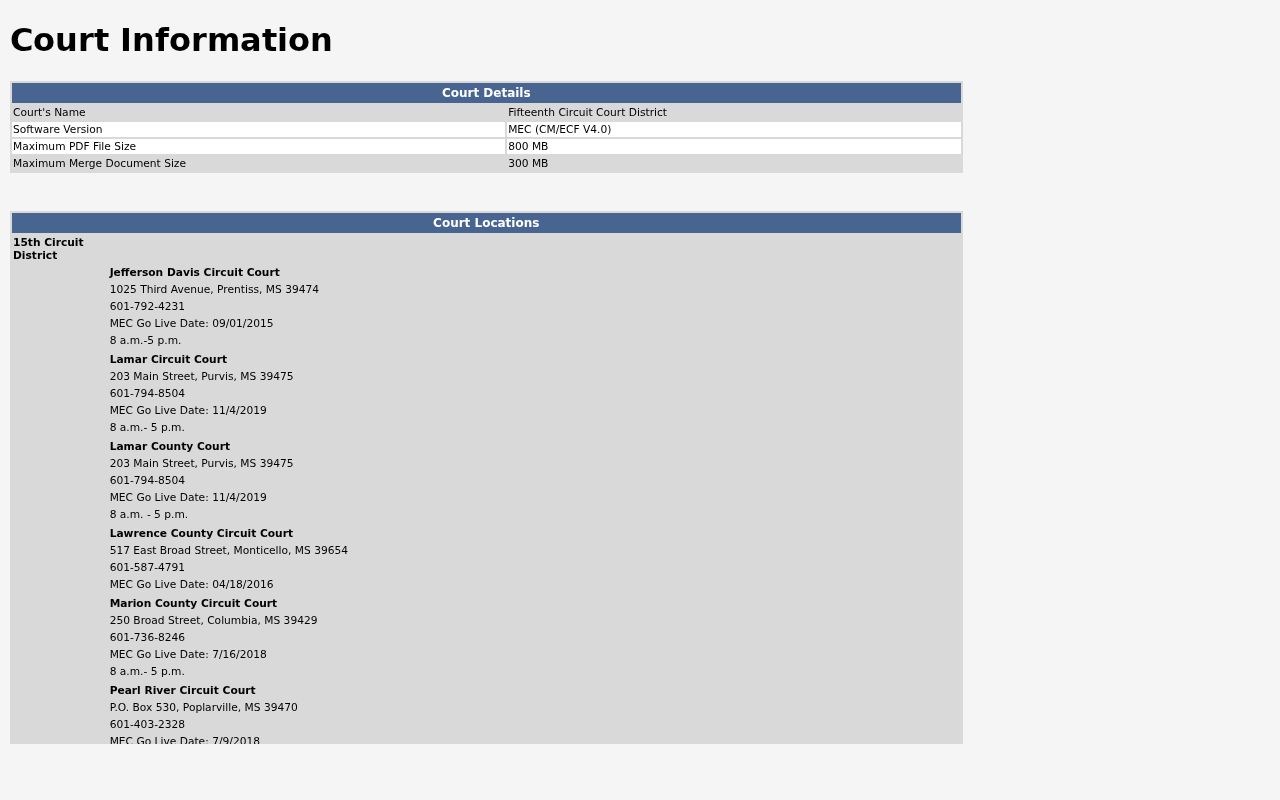
Treat CourtInfo as the map, not the destination. Confirm the system and court route there. Then turn to PAMEC, the clerk, or the courthouse terminal for actual case access. For Chancery matters, the Marion County Chancery Clerk can sort out whether a record belongs with Chancery, the land-record counter, Youth Court routing, or another office. Remember that a calendar or setting request is not a case search.
Searching by Case Number
The case number is your best identifier. Use it when a document prints one. It lets the clerk separate people with similar names. It also pinpoints the right court file faster than a broad name request. Marion publishes no documented case-number format or verified set of case-type codes. So resist guessing a pattern. Copy the number exactly as printed and name the court. The local notation to use is simply case number as shown on the court document. No number? Give the court, an approximate filing or hearing date, and a short case description instead.
Marion Circuit Case Flags
Fifteenth Circuit CourtInfo lists local workflow flags such as Arraignment Pending, BOND REVIEW, BOUND OVER, Capias Pending, Final Judgment Issued, In Custody, Nolle Pros Pending, Plea Pending, Probable Cause, Probation, Trial Pending, and Warrant Issued or Returned. A flag hints at procedural posture. It is not the controlling docket entry or order. So never label a warrant, bond, plea, or pending notation as a final result without reading the actual court record behind it.
Marion PAMEC Case Access
PAMEC is the public subscriber route for remote MEC access. Registration identifies Attorney, Non-Attorney, and Firm Administrator user types. The published non-attorney terms list a $10 annual registration fee plus a $0.20-per-page search charge. Watch out: a no-match search can still cost one page. Use a court and case number whenever possible. Card, debit, and e-check registration generally process same-day under the public materials. A physical check can delay access. The PAMEC registration screen shows the public enrollment route. It comes before remote access.
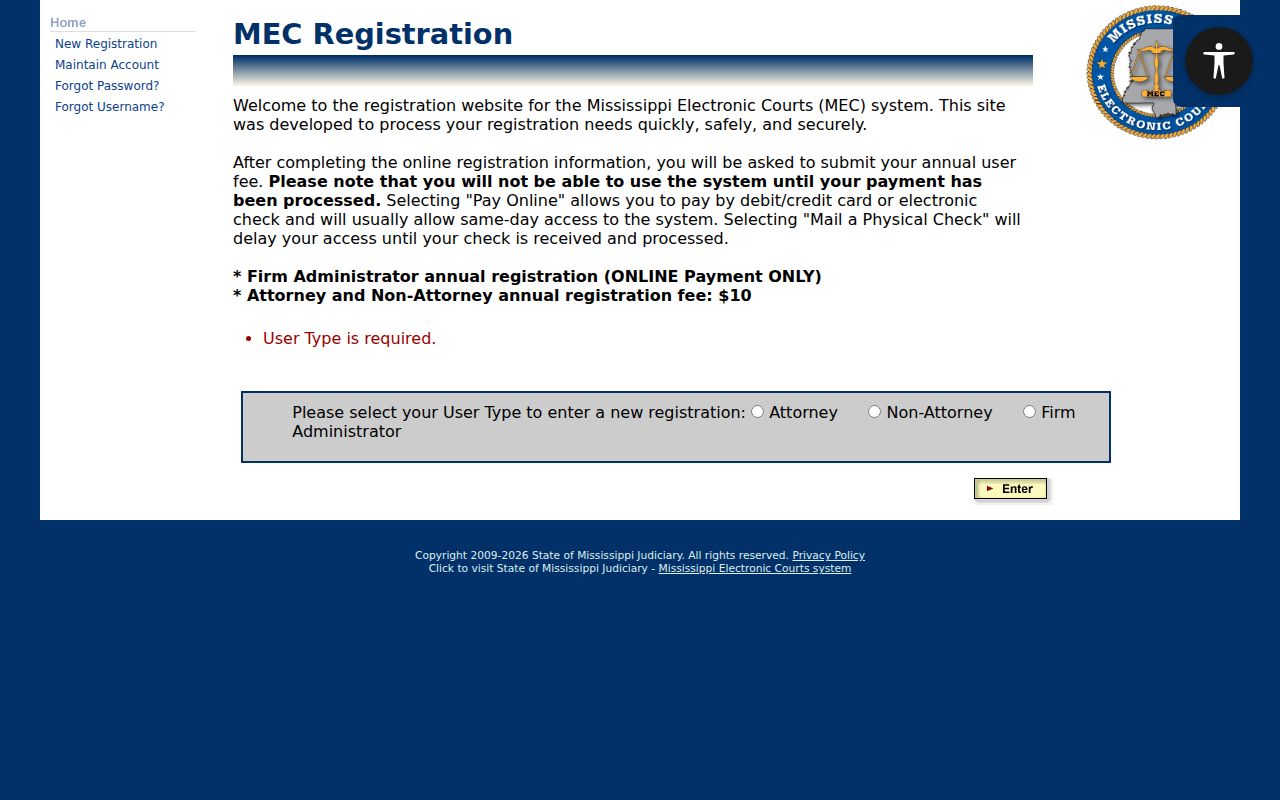
Registering creates a subscriber pathway, nothing more. Sealed, restricted, attorney-only, or expired-notice documents stay off-limits. Free electronic viewing continues at the clerk's public terminal during regular business hours under MEC administrative procedures. Call the Marion County Circuit Clerk or the Chancery Clerk before traveling with a record request.
What a Case Search Returns
The exact authenticated result layout is best confirmed after you gain access. Even so, the public MEC materials and local court practice show the core items a requester should check. Keep one thing straight. A docket entry or search result is procedural information, not a full account of the case. Read the actual order before describing any outcome. And verify that the court and county are correct.
| Case number | The court-assigned identifier used to locate the file and request copies. |
|---|---|
| Court and county | Confirms the Marion Circuit, Marion Chancery, Justice Court, or Columbia Municipal route. |
| Case style or parties | A caption or role description when public; sensitive matters may limit display. |
| Filing and event dates | Dates for opening papers, docket activity, settings, or orders. |
| Case type and status | Procedural category and status markers that should be read with the underlying entry or order. |
Marion Chancery Case Flags
Tenth Chancery CourtInfo speaks a different local vocabulary. Its labels include accounting due, adult or minor ward, appeal, conservator or guardian plan, DHS, GAL, inventory, and mediation. Sealed, show-cause, trial pending, trust, and well-being-report indicators round out the set. Those flags help distinguish a possible Chancery workflow from a public case outcome. They also explain why a clerk may need to review confidentiality, redaction, or a court order. That review comes before a document is released.
Marion Case Search Billing
Read the PAMEC terms before you run your first Marion County case search. Searches bill per page. Even a no-match result still produces one billed page. Treat a remote docket search as paid account activity. It is not a free countywide index. Keep notes on the court, the query date, and the result status. That helps if a clerk request comes later. PAMEC also warns that access can be restricted for congestion or misuse.
The public non-attorney PAMEC terms lay out the annual fee. They also list the per-page charges and all account conditions.
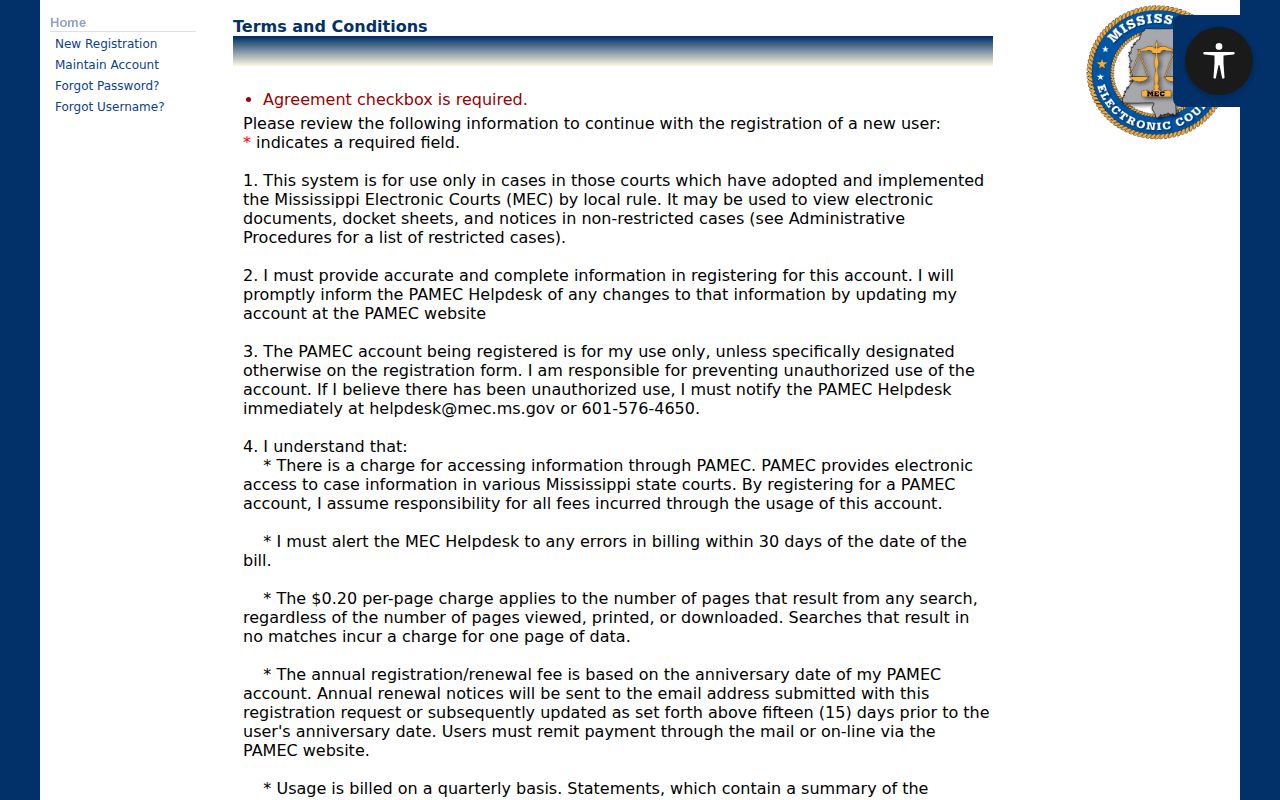
When remote access stops being useful, two other options remain: the free courthouse terminal and a records request made directly to the clerk.
Statewide vs County Case Search
Mississippi Electronic Courts is the statewide system, but Marion County is not one anonymous portal. The remote public route is PAMEC, and Circuit and Chancery remain separate destinations. Other tools answer narrower questions. The land portal indexes recorded instruments. MyFinePayment handles eligible citation payment and notification. Clerk counters hold the court-specific records themselves.
| MEC and PAMEC remote layer | Marion local route |
|---|---|
| Separate Fifteenth Circuit and Tenth Chancery systems | Clerks identify the correct Circuit, Chancery, Justice, or municipal custodian. |
| Restricted login and paid public subscriber access | Free MEC viewing at a clerk public terminal during regular hours. |
| Electronic docket and document access subject to permissions | Plain or certified copies requested from the office that keeps the original record. |
| Not a Justice Court or Columbia Municipal Court docket | Use the citation and issuing court for lower-court traffic or municipal matters. |
Marion Case Lookup Boundaries
The Tenth Chancery MEC login marks the access boundary for Chancery case records. A login screen is not a docket. A land instrument is not proof that a case exists. Neither is a calendar event or a setting form. The Chancery calendar does search event keywords, and setting forms collect case information for administrators. But neither serves as a public person-level docket lookup.
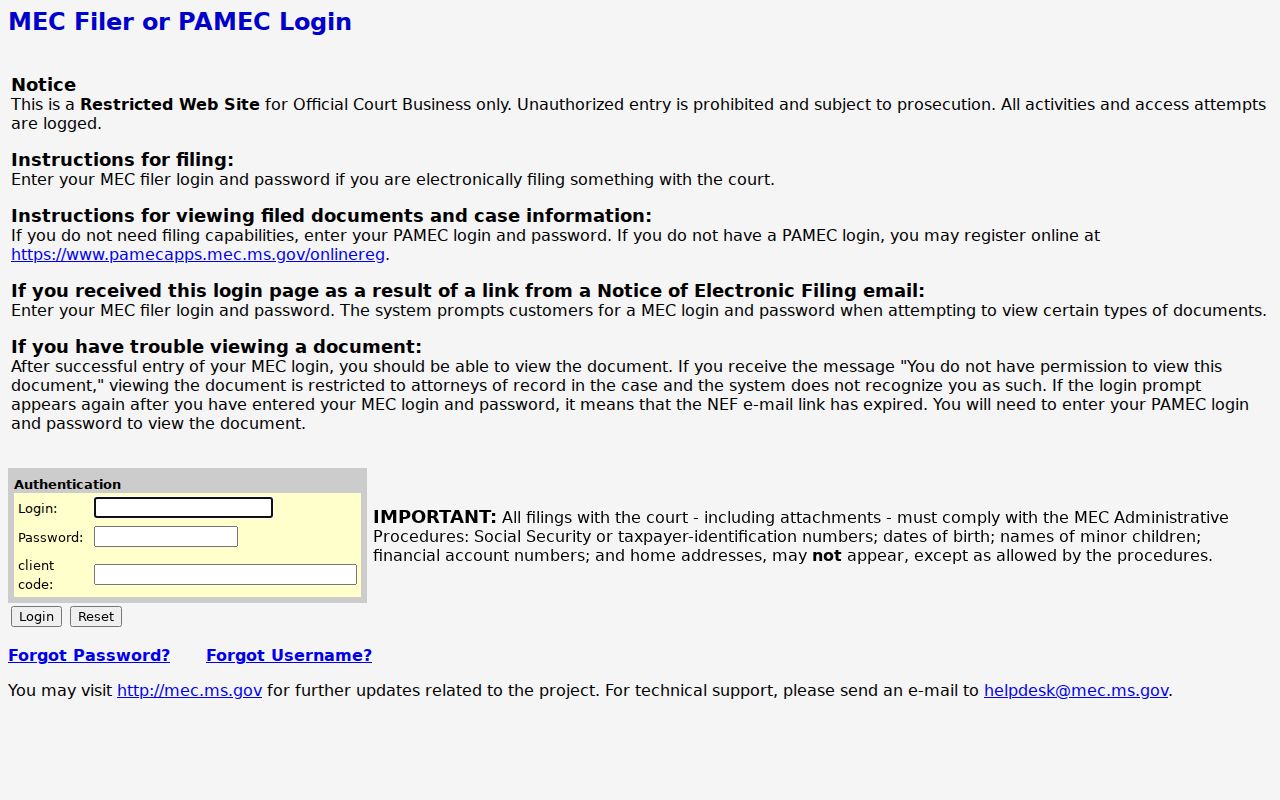
That login screen draws a clear line between an open CourtInfo page and a case file. The case file needs the right account or a clerk request.
The Marion land-record search is an open instrument index. Filters cover party, date, instrument, book and page, legal description, and parcel. It works well for finding a deed, mortgage, lien, or lis pendens. It is not a lawsuit docket, though. The county-advertised MyFinePayment tool is similar in spirit. Select a jurisdiction, then supply two of last name, date of birth, or citation number. It searches an eligible citation. It is not a general Justice Court case search.
Marion Clerk Case Access
Remote MEC access is only one route to Marion County court records. Circuit Clerk Janette Nolan's office sits at 250 Broad Street, Suite 1, Columbia. The Chancery Clerk's office is at 250 Broad Street, Suite 2. Either clerk can confirm the right court and the current procedure for a case-record request. Ask about the public terminal, mail, fax, email, phone, or a counter visit. Which one works best depends on your request. No universal response time or standardized request form is promised.
Marion Citation Case Lookup
Justice Court citations follow a different path than MEC. MyFinePayment can pull up an eligible citation once a jurisdiction is chosen and two identifiers are supplied. The Justice Court clerk holds the actual court record, though. Need a certified disposition or answers about a hearing date? Call the clerk. Ticket information is typically uploaded within ten days of the court date. A missing portal result is a reason to call. It is not proof that no case exists.
Access and Restricted Cases
"Not found," "not online," "restricted," "sealed," "expunged," and "not public" mean different things. MEC screens can limit a document to attorneys of record. They can also deny access after an electronic-notice period. Circuit and Chancery files carry sealed, restricted, and expunged markers too. Youth Court records have their own confidentiality protections. Domestic, adoption, guardianship, commitment, and other sensitive files may require redaction. Some need a court-specific access decision instead.
Public access has limits. Mississippi's public-records baseline in §25-61-2 and inspection and copying procedures in §25-61-5 work alongside court orders, redaction rules, expungement provisions, and the confidentiality rule for Youth Court records in §43-21-255. Ask the clerk for the governing access basis or a redacted copy; do not try to reconstruct a restricted matter through other indexes.
For a Circuit or Chancery record you cannot reach remotely, contact the proper clerk by phone, mail, fax, email, or at the counter. Ask what information a lawful request requires. The court can confirm whether the item is public and whether a plain or certified copy is available.