
How to Search Criminal Dockets
Marion offers no free, anonymous, countywide criminal case search. For Circuit Court, open the public Fifteenth Circuit MEC CourtInfo page first. It confirms the court and explains the status vocabulary you will see. The case interface itself stays restricted. Remote public access runs through the PAMEC subscriber path. A clerk's public terminal gives free electronic viewing during regular business hours. Justice Court records take a different route through the Justice Court clerk.
Always search with the court-assigned case number when you can. A citation, charging paper, or prior notice may also name the right court. Call the clerk if the court is unclear. Name-only docket searches match poorly. An absent, sealed, or permission-limited result never proves the case did not exist.
- Identify whether the matter is in Marion Justice Court, Marion Circuit Court, or Columbia Municipal Court from the case paper or citation.
- For a Circuit matter, use CourtInfo to confirm the MEC court, then register for PAMEC if remote case access is needed.
- Search with the court-assigned case number when available, then compare the court, filing date, and case type before relying on a result.
- Read the docket entries for the next setting, filing, order, and any access flag rather than treating one status label as the whole case.
- Ask the clerk for a plain or certified copy when the needed record is not available electronically or requires official certification.
Marion Criminal Docket Access in MEC
Marion Circuit criminal activity lives inside the Fifteenth Circuit MEC system. MEC CourtInfo is public. CourtInfo shows court information and selected flag definitions. The login screen, though, offers no anonymous person-level criminal docket. For remote access, PAMEC is the route. Its non-attorney terms list a $10 annual registration charge plus $0.20 per search page. The charge applies even on a no-match page. The clerk's terminal still matters for free electronic viewing. It also serves readers who cannot keep a remote account. The Fifteenth Circuit MEC login shows the restricted-access boundary that applies to Marion criminal docket records.
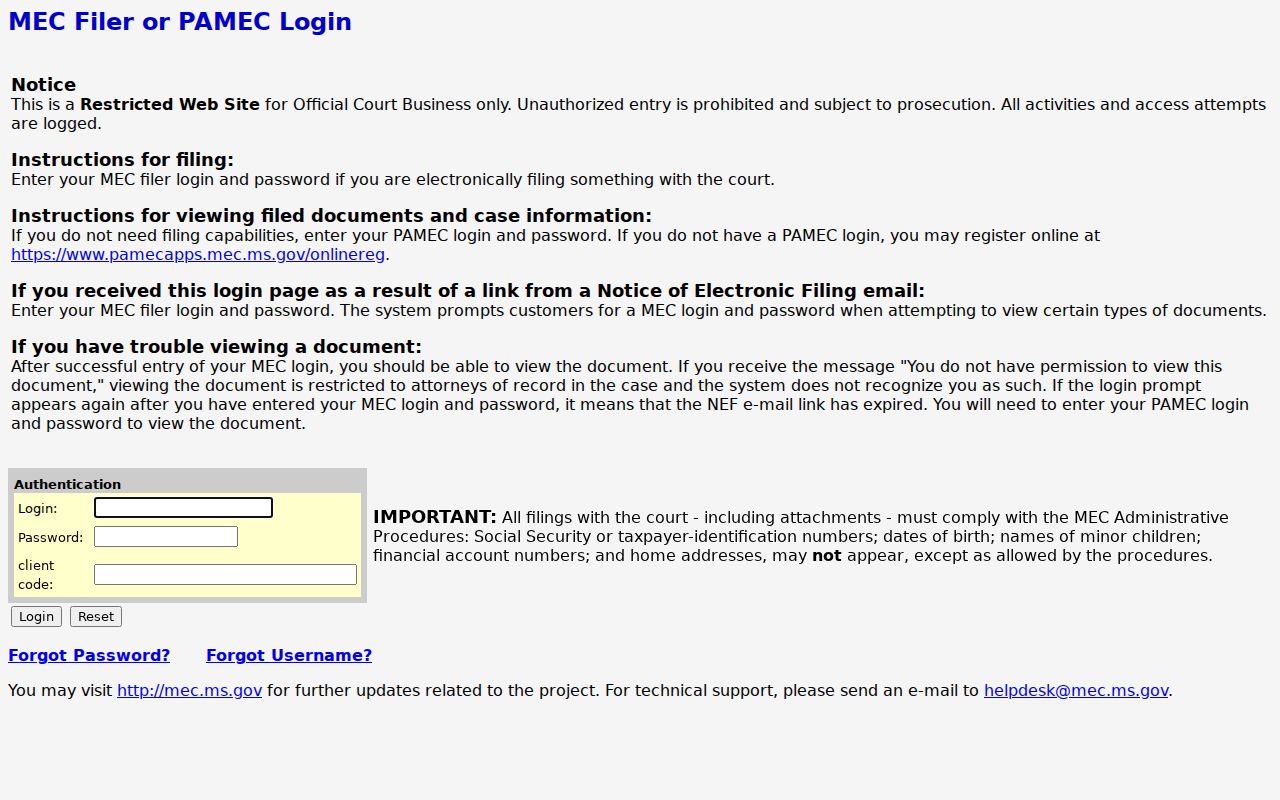
A public landing page is not proof of open case-level access. Login rules, a seal, attorney permission, or an expired notice can block a document. When that happens, the restriction is real. The practical next step is the Circuit Clerk or the clerk terminal. Do not try to work around it.
What a Criminal Docket Shows
A Marion criminal docket is a procedural chronology, nothing more. It can identify many things depending on the court. The list covers the court, filing date, case type, parties and counsel, setting dates, event descriptions, document links, disposition information, and access flags. Exact interface labels vary. Read the linked order when one is available. A short docket label never carries every fact or legal effect.
| Case Number | The court-assigned identifier, such as the case number shown on a notice; it is the best search and request key. |
|---|---|
| Court and County | Shows whether the entry belongs to Marion Circuit, Justice, or another court route. |
| Charge or Case Type | Identifies the criminal matter and helps distinguish it from a civil, traffic, or municipal record. |
| Settings and Events | May show an arraignment, bond review, plea, hearing, trial, motion, or other dated court action. |
| Disposition and Access | Can show a final judgment, nolle prosequi, costs, seal, restriction, or expunction marker when applicable. |
Charges, warrants, and pending pleas are procedural entries. Treat them as case history, not as a conviction or a complete statement of the outcome.
Marion Criminal Docket Status Flags
Fifteenth Circuit CourtInfo lists criminal workflow flags. These can help a Marion reader see where a case sits. A flag is not a narrative finding. It may mark a pending event. It may show a clerk workflow step. Or it may signal a document still waiting to be entered. For what the court actually did, the docket entry and any public order remain the better sources.
- Arraignment Pending
- An arraignment event remains to be handled or recorded.
- Bound Over
- A Justice Court felony process has moved toward Circuit Court after the lower-court stage.
- Capias or Bench Warrant
- An arrest-process marker; issued and returned are separate events.
- Nolle Pros Pending
- A prosecution-related nolle prosequi entry is pending; read the order for its effect.
- Final Judgment Issued
- A final adjudication or order has been entered, but the judgment itself supplies the controlling details.
Other markers include bond paid, bond review, probable cause, plea pending, probation, trial pending, warrant issued or returned, and cost bill. Confirm any status label with the court. Treat none as current without checking.
Stages on a Criminal Docket
Marion criminal routing can begin in Justice Court. The county describes felony initial appearances and affidavits there. A felony case may then move toward Circuit Court. The path runs through probable-cause and bind-over steps. Misdemeanors, DUI, traffic, and county-ordinance matters can stay in the lower court. The court named on the paper controls the search route.
Docket flow: Initial appearance or charge › arraignment › pretrial setting › plea or trial › disposition › sentencing or final judgment.
Not every case takes every step. A calendar date is not itself a result. CourtInfo's bound-over, probable-cause, bond, plea, trial-pending, and final-judgment flags can place an entry within the sequence without settling what it means.
Marion Criminal Docket Routes in Justice Court
The Marion County Courts page identifies Justice Court as the route for misdemeanors, DUIs, county ordinances, traffic and other listed tickets, and felony initial appearances. It also names the Justice Court clerks who handle the local criminal and civil work. MyFinePayment may support an eligible citation payment or notification. It is not a general criminal docket, though. It also cannot replace a certified case record.
| Record question | Marion route | Why the route matters |
|---|---|---|
| DUI, misdemeanor, ordinance, or initial appearance | Justice Court clerk | These lower-court records may not appear as a Circuit criminal case. |
| Felony filing, indictment, or Circuit setting | Fifteenth Circuit MEC or Circuit Clerk | Circuit records carry the felony docket activity after the appropriate lower-court process. |
| City ordinance or city traffic matter | Columbia Municipal Court clerk | Municipal cases are separate from the county Justice Court route. |
For a certified Justice Court criminal disposition, call the clerk at 601-736-2572. Identify the case, citation, or date range. The county posts no open Justice Court docket database and no general online criminal search form.
Marion Criminal Docket Bind-Over Path
For a Marion felony, the county describes an initial appearance and affidavit in Justice Court. Probable-cause and bind-over steps may follow, moving the matter toward Circuit Court. CourtInfo lists both Probable Cause and Bound Over as criminal workflow flags. Those entries mark procedural movement, not guilt or a final result. A docket search can land in the wrong place. Some readers chase the earliest lower-court paper. The case has already moved to Circuit Court by then. They risk exactly that.
Which Court Holds Criminal Dockets
Felony cases in Marion County go to Marion Circuit Court, part of the Fifteenth Circuit Court District. The Circuit Clerk's functions page spells out what lands in a criminal file. Indictments and motions come through that office. The clerk records judgments and executions. Jury administration sits there too. Those duties explain why a Marion Circuit criminal file can contain more than the public calendar or a payment notice ever shows. Justice Court is the county's lower criminal route. Columbia Municipal Court separately handles city ordinance, city traffic, and municipal misdemeanor matters, while Youth Court records run through Chancery-linked administration, stay confidential, and are no public criminal name-search alternative for Marion County.
Marion Criminal Docket Date Confirmation
The Fifteenth Circuit posts separate date-request instructions for its judges. A Marion criminal setting can look murky. A PDF or docket entry does not always make the date clear. That is when the listed administrators help. The court warns about one catch. A filing through MEC can still require a copy to the judge or administrator. Keep the case number, judge, county, requested date, and setting type together. Then ask whether a calendar date applies to your case.
Marion Criminal Docket Calls and Settings
A published Circuit calendar is a schedule, not a report of case results. The 2025 sample labels the settings. Criminal docket call, recalls, pleas, sentencing, revocations, omnibus hearings, bad-check matters, and show-cause settings all appear there. Docket call dates show up too. The current 2026 Harrell hearing and plea PDF lists Marion entries at 09:00 on set dates. Some of those dates follow docket call. A prior term pattern is not a promise. Use the current judge-specific PDF. A docket call organizes cases and settings, while a plea, sentencing, motion, or trial setting does different work. Judge-specific instructions also say motions may be requested through each judge's process, with copies to the judge even when filed in MEC, so confirm any setting with the court or administrator before you act on it.
Marion Criminal Docket Expunction Boundary
An expunged or restricted Marion criminal record is no ordinary public search result. Mississippi Code Section 99-19-71 supplies the petition and nonpublic-retention framework for listed matters. Expungement fees are listed separately. The Circuit Clerk's current fee schedule states its own conditions for those charges. Eligibility is a legal question. No docket label can decide it. Verify the current statute first. Check the clerk fee and court procedure too. Then treat a Marion entry as expunged.
Public Access and Sealed Criminal Dockets
Mississippi's public-records baseline does not make every Marion criminal docket field or document unrestricted online. MEC can limit a document in several ways. Seals, restrictions, attorney-only permissions, and expired notice access can all apply. Protected personal identifiers get attention too. The login notice addresses them. Ask the clerk whether a public redacted copy, plain copy, or certified copy exists rather than trying to reconstruct a restricted record from another source.
Key Rules:
Mississippi Code § 25-61-2 establishes a general public-records baseline, subject to lawful exemptions and court restrictions.
Mississippi Code § 99-19-71 governs specified expunction procedures and nonpublic retention rules.
Mississippi Code § 43-21-255 makes Youth Court and child records confidential except for narrow statutory access.
An expunged, sealed, restricted, or absent result is an access boundary, not an invitation to search for personal identifiers elsewhere. The clerk or court can explain it.
Marion Criminal Docket Copies and Verification
For Circuit criminal records, give the Circuit Clerk the court, case number if known, date range, and the document you want. Say whether you need a plain or certified copy. The current clerk fee sheet breaks down the charges. A civil or criminal search covering a ten-year period costs $10. Staff copies run $1 per page. Self-service or electronic copies made by staff cost $0.50 each, and certification with an official seal adds $1 per document. Confirm the charge before paying. An older county fee page conflicts with the dedicated current schedule, so check the delivery method too.
For Justice Court, call 601-736-2572 and name the criminal, traffic, fine, or initial-appearance record you need. The court can say whether it is the custodian. It can also tell you whether an entry is public or whether another Marion clerk holds the case file. A docket entry helps with status. But the signed order or certified record is the better verification source.